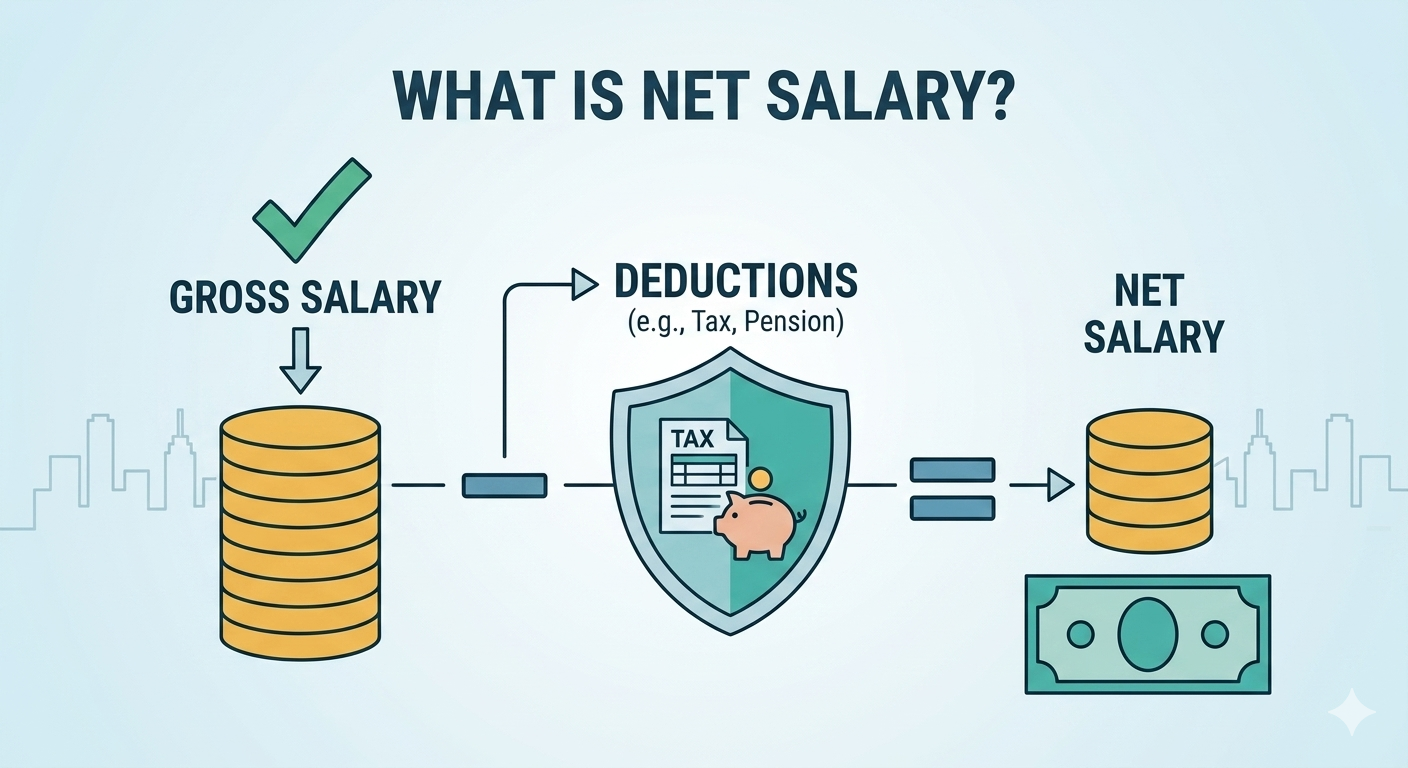
Short answer: Net salary is the amount that actually lands in your bank account after your employer removes tax, pension, and other statutory deductions from your gross pay. If your offer letter says ₦300,000, your net salary is whatever’s left once PAYE tax, 8% pension, and NHF contributions come off the top — usually landing somewhere between ₦240,000 and ₦280,000 depending on your allowances and reliefs.
That gap between the number on your offer letter and the number in your account trips up a lot of first-time employees. Let’s fix that.
Gross Salary Vs Net Salary: The Real Difference
Gross salary is everything — basic pay, housing allowance, transport allowance, every line item combined before anyone touches it.
Net salary is what survives after deductions. Nigerians sometimes call it take-home pay, and that phrase captures it better than any textbook definition.
Here’s the part people miss. Your employment contract almost always quotes gross salary. Unless you specifically ask for net figures, you’re negotiating a number you’ll never actually see in full.
What Actually Gets Deducted From Your Gross Pay
Three things typically eat into your gross salary before it becomes net: PAYE tax, pension contribution, and sometimes NHF.
PAYE, short for Pay-As-You-Earn, is personal income tax deducted directly by your employer and remitted to the tax authority on your behalf. You never see this money — it disappears before payday even happens.
Pension contribution sits at 8% of your basic salary, housing allowance, and transport allowance combined, mandatory under the Pension Reform Act for organizations with 15 or more staff. NHF, where applicable, takes another 2.5% of your basic salary.
The New Tax Rules That Changed Everything In 2026
Nigeria’s tax system got a major overhaul. The Nigeria Tax Act 2025, effective January 1, 2026, replaced the old 7% to 24% PAYE structure with a new framework.
The headline change: the first ₦800,000 of your annual chargeable income is now taxed at 0%. That’s a meaningful shift from the old system, where even modest earners started losing money to tax almost immediately.
Above that threshold, rates climb progressively — 15%, 18%, 21%, 23%, and 25% at the very top for income above ₦50 million annually. Most workers earning between ₦1.5 million and ₦25 million yearly should see their net pay improve compared to the old bands.
Chargeable Income: The Number That Actually Gets Taxed
Your chargeable income isn’t your gross salary. It’s what remains after subtracting allowable reliefs — pension, NHF, rent relief, and qualifying life insurance premiums.
Rent relief works out to 20% of your annual rent paid, capped at ₦500,000. If you’re not claiming this, you might be overpaying tax without realizing it.
This matters because two people earning the same gross salary can walk away with very different net pay, purely based on which reliefs they’ve claimed and documented.
A Real Example, Worked Through
Take someone earning ₦200,000 monthly gross, or ₦2.4 million annually. Pension takes 8%, roughly ₦192,000 for the year. NHF, where applicable, takes another 2.5%, around ₦60,000.
After these reliefs, chargeable income drops to approximately ₦2,148,000. Run that through the new 2026 bands, and annual PAYE comes out around ₦202,200 — roughly ₦16,850 monthly.
Compare that to the old system, where this same earner would have paid closer to ₦280,000 annually. That’s real money staying in pocket, not just a policy talking point.
Why Your Payslip Never Matches Your Offer Letter
Recruiters quote gross figures because it makes offers look more competitive. Nobody negotiates a job by advertising the smaller number.
But once statutory deductions apply, that ₦300,000 monthly offer often settles somewhere around ₦255,000 to ₦280,000 net, depending on your specific allowances, pension rate, and whether NHF applies to your employer.
Ask your HR team for a net salary breakdown before accepting any offer. It takes five minutes and saves you from budgeting around money you were never going to receive.
NHF: Mandatory Or Optional?
This one confuses people constantly. NHF remains mandatory for public sector employees. For private sector workers, contribution rules shifted under the newer tax framework, and it’s increasingly treated as voluntary depending on your employer’s policy.
Check your specific employment contract. Some private companies still deduct NHF automatically; others have stopped since the reforms took hold.
Employer-Only Contributions You’ll Never See Deducted
Not every payroll line comes out of your pocket. Employers also contribute toward pension — typically 10% on their side — and cover items like the Nigeria Social Insurance Trust Fund contribution entirely on their own.
These employer-side contributions never touch your gross salary calculation, which is exactly why your net pay math should only ever include the deductions actually taken from your check.
How To Calculate Your Own Net Salary
Start with annual gross income. Subtract pension (8% of basic, housing, and transport combined) and NHF where applicable. Subtract rent relief if you qualify. What remains is chargeable income.
Apply the 2026 tax bands progressively — the first ₦800,000 at 0%, then the climbing rates above that threshold. Divide the resulting annual PAYE by 12 for your monthly deduction.
Subtract PAYE, pension, and NHF from gross, and what’s left is your net salary — the number that actually shows up when your alert comes through.
Why This Understanding Protects You
Knowing the difference between gross and net salary changes how you negotiate job offers, budget monthly expenses, and evaluate whether a new role is genuinely better paying than your current one.
A ₦50,000 gross increase means nothing if it pushes you into a higher chargeable bracket that eats most of the gain. Understanding PAYE structure in Nigeria before signing any offer letter puts you in a stronger negotiating position than most candidates ever bother to reach.
Bottom Line
Net salary is your real income — what survives after tax, pension, and applicable statutory deductions strip away from your gross pay. Under Nigeria’s 2026 tax reforms, most salaried workers should see modestly better take-home pay than previous years, particularly those earning below ₦25 million annually. Know your chargeable income, claim every relief you qualify for, and always ask for the net figure before you accept any salary offer — the gross number on paper was never the real story.

Atulegwu David is a gaming enthusiast, how-to writer, and reviewer at Jobbyzi. He creates easy gaming guides, practical tutorials, plus detailed salary guides to help you know what you are really worth